Choose a GIC term by matching it to the date you’ll need the money, not by pointing at the biggest number on the board. Terms of 30 to 364 days exist to park money that has a known date; terms of 1 to 5 years exist to pay you for staying put, and almost everything about choosing between them follows from that split. (If you’re still deciding whether a GIC is the right container at all, start with what a GIC is and our look at whether GICs are worth it.)
What a short GIC is actually for
A 30-to-364-day GIC is a parking spot with a rate attached. It exists for money that is already spoken for: a house closing, a tax installment, tuition due in September, the deposit on a renovation that starts in the new year. The institution only gets to use your money briefly, so short terms usually pay less than long ones, and that’s fine. The job of this money is not to earn the maximum. The job is to sit safely, earn something instead of nothing, and be back in your account before the cheque needs writing.
For this money, the live comparison is short GIC versus savings account; the long terms were never in the running. A short GIC locks its rate for the whole stretch; a savings account rate can drop the week after you open it. When the date is fixed, that certainty is worth having. When the date is fuzzy, or the money might be needed on no notice, the HISA boards are the better place to look, because a locked term and an uncertain date are a bad pairing.
The trade inside every one-to-five-year decision
Once money has no near date, the question becomes how long to commit, and there is no term that dodges risk entirely. There are only two risks, and picking a term is picking which one you’d rather hold.
Lock in for five years, and you carry rate risk: if rates rise next year, your money keeps earning yesterday’s rate until maturity, and there’s nothing to do but watch. Stay short and renew every year instead, and you carry reinvestment risk: if rates fall, each renewal pays less than the last, and the long rate you passed up starts to look generous in hindsight.
Neither risk is a flaw to be engineered away. Suppose a one-point gap on $20,000: that’s $200 a year, every year the gap persists (round figures for easy arithmetic; the real numbers sit in the table below). That is roughly the size of the bet in either direction. Much of what moves that bet is the Bank of Canada’s policy rate, and our guide to how the Bank of Canada’s rate moves deposit rates covers the machinery.
The table below prices that trade as it stands, term by term, from our boards.
Humps, inversions, and what the curve is telling you
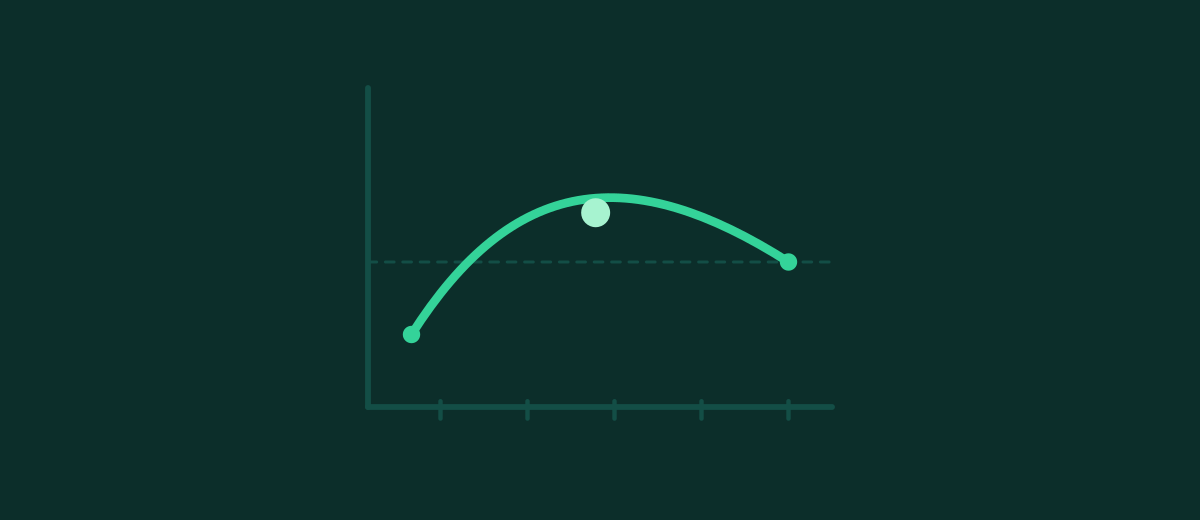
Line up an institution’s rates from 1 year to 5 and you get its term curve. The textbook shape slopes upward: longer commitment, higher rate, because the institution is paying you for the certainty of holding your money longer.
But the curve doesn’t always cooperate. Sometimes it humps in the middle, with a 2- or 3-year term out-paying both the 1-year and the 5-year. Sometimes it inverts outright, with short terms paying more than long ones. Both shapes are information. Institutions price each term from two ingredients: where they expect rates to go, and which maturities they happen to want deposits at right now. A hump usually means an issuer has an appetite for funding at that specific term. An inversion usually means the market expects rates to fall; no institution promises today’s short-term rates for five years if it expects money to be cheaper later.
So read the curve before assuming longer means more. Its shape changes, which is exactly why we don’t print one here: check the live shape across terms on the GIC boards and let the curve you actually find there inform the decision.
Match the money to a term, then commit
Two archetypes cover most real situations. The first is a house deposit needed next spring: the date is fixed, so the term picks itself, maturing a few weeks before the cheque is due. The second is money with no deadline at all: there is no date to match, so the decision reverts to the risk trade above, and the longer end of the curve comes into play.
| The money | A term that fits | The reasoning |
|---|---|---|
| House deposit needed next spring | A short term maturing a few weeks before closing | The date is fixed; protecting the deposit comes ahead of maximizing it |
| Tuition due every September | Terms under a year, timed to the due date | Each year’s bill gets its own maturity |
| A known expense two or three years out | A 2-year or 3-year term maturing just ahead of it | Matches the date, and out-earns rolling short terms when the curve slopes up |
| Money with no deadline | Longer terms, or a mix of terms | With no date to hit, the question is which risk to carry |
| Money needed on no notice | A savings account, not a GIC | Locking money you might need is how early-redemption regret happens |
And when the answer is “part of this money has a date and part doesn’t,” splitting the deposit across several maturities so that a slice comes due every year (a GIC ladder) usually answers the question better than any single term can. Whichever term wins, it’s worth knowing what happens when a GIC matures before the date arrives.
The curve’s shape is a fact about this week, so the last step is always the same: check your term’s row on the current GIC boards against its neighbours and see whether the market is paying for the commitment you’re considering. If the rate you want isn’t there yet, set a rate alert for your target term and let it come find you.
Frequently asked questions
Is a longer GIC term always better?
No. A longer term pays more only when the curve slopes upward, and even then the extra rate is compensation for locking up your money rather than free yield. When the curve is flat or inverted, short terms can out-pay long ones. Match the term to the money’s date first, then check what the curve is actually paying.
What happens if interest rates rise after I lock in?
Nothing happens to your GIC: it keeps paying the agreed rate until maturity, which is the whole deal. You can’t swap a non-redeemable GIC for a better one mid-term. That possibility is rate risk, and it’s the price of the certainty you bought on day one.
Can I get money out of a GIC before the term ends?
Only if it’s a redeemable or cashable GIC, which generally pay lower rates in exchange for the exit door. A standard non-redeemable GIC is locked to maturity, with exceptions (such as hardship) at the institution’s discretion. If early access matters, build that requirement into the decision before you buy.
What term makes sense for money with no deadline?
There’s no single right answer, because the choice is really between rate risk (locking long) and reinvestment risk (rolling short). Splitting the money across several terms carries a little of each risk instead of all of one. Check how steep the current curve is before deciding how much commitment is worth it.